
American Eigenvector
John Keats, James Joseph Sylvester, Isaiah Berlin, Keanu Reeves, Teddy Roosevelt, Linear Independence, and American Independence

“Beauty is truth, truth beauty,—that is all
Ye know on earth, and all ye need to know.”
– John Keats, Ode on a Grecian Urn
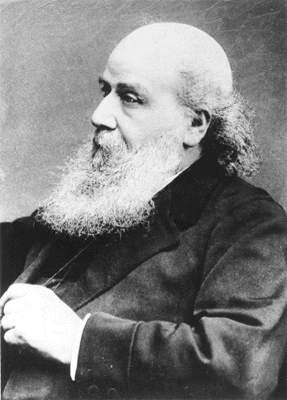
Cambridge University in 1837 and Columbia University in 1843 denied tenure to James Joseph Sylvester, an English mathematician. His shortcoming was being a Jew. Forced out of academia, Sylvester became de facto CEO of an actuarial company. But he persisted in his love of math and made major contributions to it, so that later in life the Royal Military Academy (near London) and Johns Hopkins University (near Hamsterdam), ignored his Jewish identity and let him teach.
Sylvester went on to found the American Journal of Mathematics and made key contributions to linear algebra. He even coined the term ‘matrix,’ (as far as I know neither Keanu Reeves nor anyone else involved in the films gave his estate royalties). Sylvester appreciated that for any matrix – a large set of numbers – there is an underlying truth of unchanging numbers and vectors. These underlying truths Sylvester called “latent roots.”[i]
Today, for these unchanging numbers and vectors, we’ve inherited the half-German, half-English words “eigenvalue” and “eigenvector” which sound about as peaceful as Anglo-Saxon battle axes. The German ‘Eigenwert,’ means “Inherent value.” This phrase or Sylvester’s “latent roots” are clearer to me. But we get what we get. I think of eigenvalues as simply: “the underlying truth of a system.”
Humans use eigenvalues to solve practical problems including:
Creating search engines
Controlling virus outbreaks
Weather forecasting
Financial risk management
Analyzing DNA sequences, and
Training AI models
Eigenvalues and eigenvectors are special because they do not change. Hit them with equations, mutations, shears— they stay constant. Here’s an example:
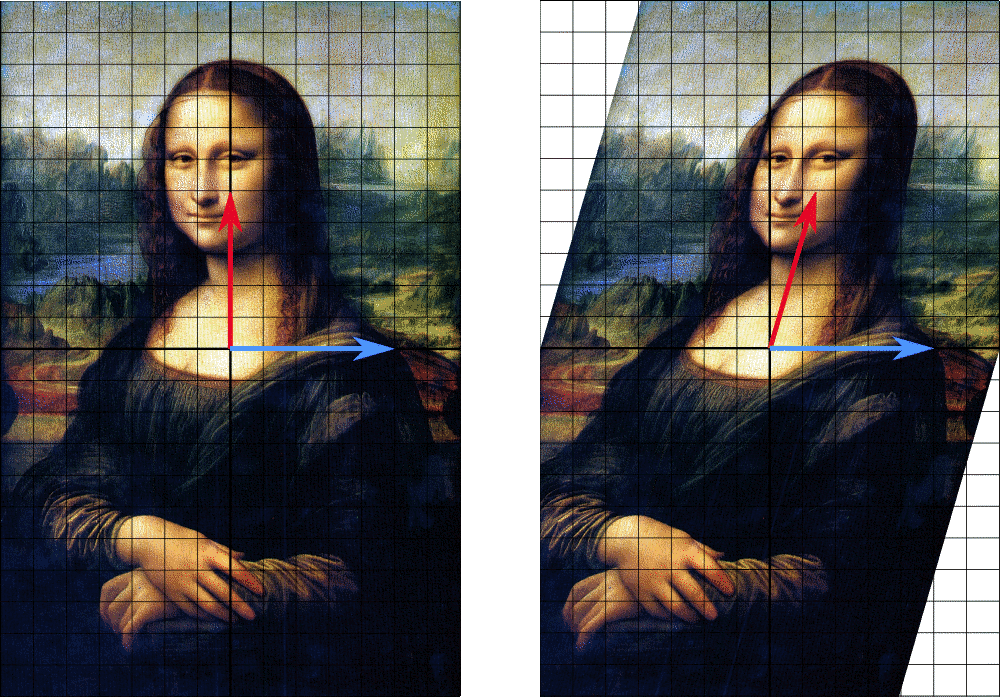
A twisting function is hitting the Mona Lisa. For the red arrow, which is not an eigenvector, the arrow and picture end up bending. But in the direction of the blue eigenvector going left to right, nothing changes. It is stable, the latent root of the system, the unchanging truth.
Another example: the C Major chord consists of a C note, E note, and G note. These three notes are the eigenvalues of the C Major Chord. You can hear the sweetness of the full chord, or you can hear it composed of those three underlying eigenvalues.
Eigenvalues and Political Polarization
Let’s apply eigenvalues to American democratic strength. It’s not as preposterous as it may sound at first. Take this made-up example:
Every month 1 in 100 Americans who wished well their fellow citizens regardless of political ideology becomes polarized, now seeing them as moral enemies.
Every month 3 in 100 Americans on the far-left or the far-right reject ideologies that harm themselves, their friendships, and their country, and embrace national unity.
We can summarize this situation with two equations:
Number of Unifiers 1 month from now = 0.99 x Unifiers + 0.03 x Partisans
Number of Partisans 1 month from now = 0.01 x Unifiers + 0.97 x Partisans
What happens to that society over time?
If 80% of Americans, 200 million adults, are not polarized then every month 2 million Americans (1 in 100) become polarized.
Out of the 50 million Americans who are polarized, then every month 1.5 million of them (3 in 100) return to embrace each other.
So, net 500,000 Americans every month become mutual enemies. Each year, 6 million Americans are radicalized, supporting policies attacking each other.
We’re doomed to tear each other apart!
The twelve people on earth who read things on the internet carefully will have noticed the sloppy math. There won’t be a change of 500,000 every month. As the ranks of Partisans swell, their losses will increase, while the ranks of Unifiers will decrease more slowly. Eventually, equilibrium will be reached and radicalization will cease.
When will that happen? To find the answer to these two equations, you need to multiply out every month. You could use a computer.
Or you could find the eigenvalues and eigenvectors. The numbers at the core of this system: the underlying truth.
When you calculate the eigenvectors, they are (a) 3 and 1 and (b) 1 and -1. (See, no need to fear the Anglo-Saxon battle ax; eigenvectors here are just two pairs of two numbers).
When you multiply this Unifier-Partisan scenario out over every month for thousands of months— math that eigenvectors make easy — you discover that the only eigenvector that persists is 3 and 1 . The other pair stops mattering.
And that’s your answer: we end up with a 3:1 ratio of Unifiers to Partisans. The system balances out at 187.5 million Unifiers to 62.5 million Partisans. 3:1.
The eigenvector saw through those month in and month out difficulties. It is the C note, clear and pure.
The Actual World of People
For better and for worse, the world of human hearts does not operate like math. No equation predicts how people become polarized or maintain openness to others.
Sadly—and damagingly— many thinkers have proposed that there is an underlying predictable order to history. Rousseau, Hegel, Spengler, and most famously Marx put forth some of the most consequential ideas about history’s predictability with the resulting destruction of human life and human liberty to think and believe as conscience dictates. Philosophers like Isaiah Berlin (who, despite being a Jew, at least had the good sense to be born a late 20th-Century Jew so Oxford gave him tenure; Oxford, to its credit, also gave Sylvester tenure at the very end of his life), critiques those who argued history must follow a given course as providing:
“The argument used by every dictator, inquisitor, and bully” namely that: “I must do for men (or with them) what they cannot do for themselves, and I cannot ask their permission or consent, because they are in no condition to know what is best for them.”[ii]
So, let’s not apply math to human hearts and impose a delusional order on others.
But, we can talk about non-predictive forms of truth, the eigenvalues of American society. For though American eigenvalues cannot tell us how things ought to be or will be, they can—as an idea—tell us how things are.
What is the Underlying Truth about America?
When I lived in England, I never could get comfortable with the genuine love they felt for their monarch. I was too enamored with American history to forget what British monarchy meant to the American colonies. But the English people largely loved their monarch. It symbolized protection, virtue, and tradition. It gave order and meaning to their lives.
On my recent trip to Denmark, I had a similar experience. A former long-haul truck driver who’d lived his whole life in Esbjerg, told me that in his 60 years of experience, “nothing had changed in Denmark.” “Really?” I replied. He answered, “Yes, because we have a king. So everything stays the same. It’s wonderful. Not like you have in America where every four years everything changes.” I bit my tongue and did not cite many facts and figures to demonstrate that Denmark has radically transformed economically, socially, and demographically in the last 60 years. It would not have mattered. The truth carved into his heart is that “My country, Denmark, is unchanging and safe because we are a constitutional monarchy and that affords me identity, security, and dignity.”
So, when I think about America’s eigenvalues, it’s in this international context and what I’ve been fortunate to see in my time spent living in and visiting Europe, Latin America, Asia, and Africa.
As Tocqueville was one of the first to observe, America is a democracy through and through. It is headstrong. A nation ruled by an unruly people. As Teddy Roosevelt wrote about America’s founding generation:
“So fierce had they been in their opposition to the rule of foreigners that [Americans] were now hardly willing to submit to being ruled by themselves.”
America is ribboned with tens of thousands of miles of highways. It bursts with right-angled soybean and corn fields and 200-acre factories and skyscrapers it invented and Corinthian-columned government buildings echoing the Roman Republic. But these physical attributes hide the wildness that built it.
Americans are a wild people. This is, so to speak, the country’s eigenvalue. Its underlying truth.
Americans have a manic energy. Americans scorn others telling them what to do. Americans insist that no one is inherently better than anyone else. Americans foster a creative and world-transforming society, and a self-centered and anti-elitist one, too. It’s no surprise then that Americans and their leaders, throughout history and today, behaved and behave in ways I find unconscionable: insulting fellow citizens, persecuting political enemies, abandoning allies, and pursuing nice-sounding policies that inflict immense harm.
And America has ended up being unique: the unwilling world leader in military, diplomatic, economic, and cultural power, advancing the wellbeing of billions at home and abroad. Most recently, American leadership will play a role in helping save the life, I hope and pray, of my cousin Alon Ohel, who may come home to his family in 24 hours after two years living chained up and starved in a dungeon 100 feet underground.

To quote Winston Churchill on something he probably never said but captures America’s spirit so well that Americans love repeating it:
“Americans can always be trusted to do the right thing, once all other possibilities have been exhausted.”
Americans have a track record of coming together to achieve what is necessary—defeat the British, create a Constitution, make peace with the British, defeat the British again, make peace with the British again, secure frontiers, end slavery and establish federal supremacy, overcome industrialization’s social upheaval, help end Europe’s Great War, help end Europe and Asia’s World War, secure Civil Rights, stand up to Soviet conquests, build schools, build roads, etc. —but often not until the last possible minute.
The world bombards us daily with words and videos of anger, hatred, and fear. It’s easy to mistake these emotions for truth. But the truth is not what’s shoved in our faces. The truth is what we accept into our hearts. No matter whether a system of equations has two dimensions or billions of them, eigenvalues and eigenvectors overcome all the complexity. They shine as unbending, unbowed truths. They remind us that we can find the important truths we seek. And understand about America. Understand about ourselves. When we are honest, our world need not be bewildering nor frightening. Beauty is truth, and truth beauty.
[i] Ellenberg, Jordan. “Shape: The Hidden Geometry of Information, Biology, Strategy, Democracy, and Everything Else.” Penguin Press: New York, NY, 2021. P. 285-298. I’m grateful to this book for its many eigenvalue examples, most of all the C Major Chord example.
[ii] Berlin, Isaiah. “Two Concepts of Liberty,” Four Essays On Liberty. Oxford, England: Oxford University Press, 1969, p. 118-172.