
Seductive Universalism
Accepting the customs and stories of others instead

We lurch from crisis to crisis. In so many ways.
At a real estate conference last week at the World Trade Center, I looked out at the frozen Hudson River, the stone municipal buildings, the glassy skyscrapers, the broad avenues plowed in right angles, and the bridges anchoring Manhattan to the rest of the world, and amidst this view of order and predictability, I saw a slide that made me laugh out loud because of how humans create self-imposed chaos. It was this:
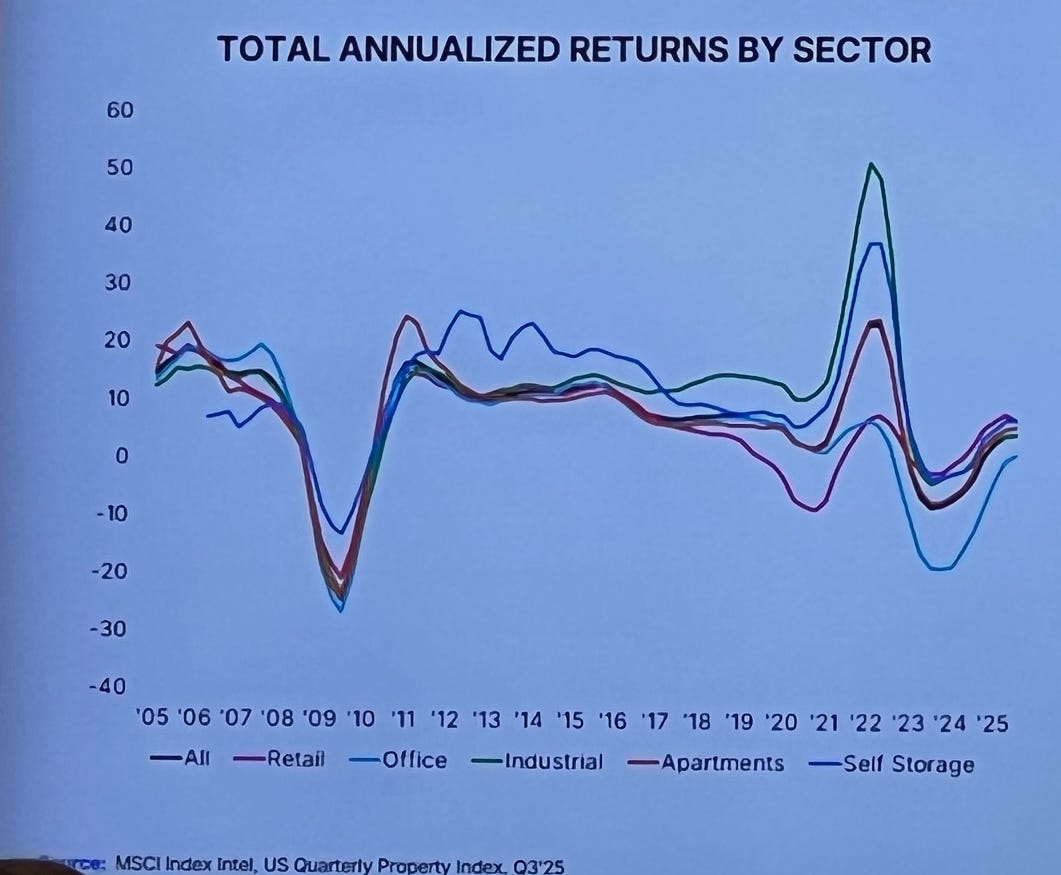
It’s a picture of investment returns by real estate asset classes over time, and it can be summarized as: returns steadily get lower, then crisis! Panic! Sell everything. Then big returns! Then returns get steadily lower, but then crisis! Sell everything! But wait! Huge boom opportunity, get it now! Oh no, crisis again – sell everything! Oh, things are settled in again….
This picture is not a historical aberration. As long as we have historical data, receding well into the 19th century, we see this same “boom-and-bust” pattern. Humans get excited about economic opportunity; that opportunity slowly gets cornered; there is a shock, people panic, and then they recover and see opportunity again, etc.
We are inclined to panic.
We are inclined to emotional thinking and emotional actions.
Emotional decision making and lurching plays out in our politics, too.
So, what I want to explore today is one of the causes of this lurching: the fact that individuals often think their beliefs are universal truths when in fact they are socially-conditioned cultural truths. And this leads to moral conflict. But we as humans can serve ourselves and our community and our country well if we act on our unique gift: being able to question ourselves and act and think slowly.
The Cultural Norms of Politics
Here are two invented examples about how different Americans react to Immigration and Customs Enforcement (ICE).
It is unconscionable that employees of the federal government force their way into neighborhoods where they are not welcome and execute American citizens who protest. ICE is persecuting migrants who are uniquely vulnerable, forcing them into hiding in their homes, unable to go out to get groceries or send their kids to school. Alex Pretti was knocked down for helping a fellow protester back to her feet. Then, for daring to protect the marginalized against ICE’s power, he was shot in the back while already subdued. It proves that the rule of law is under threat in this country, and that Trump, Republicans, and MAGA people are xenophobes out to destroy American democracy and rule indefinitely.
It is unconscionable that American citizens interfere with the work of the American government in its proper federal power of managing our borders including arresting and deporting people who cheat our immigration system. Millions of people are illegally working and cutting in line for work in front of legal immigrants and American citizens. It is an outrage that when law enforcement goes to arrest these law breakers, citizens outright obstruct the execution of justice. They hide law breakers. They assault law enforcement. Democrats and lefties and all their powerful allies in media and business are out to drown America in anarchy.
These vignettes are not endorsements. They are illustrations that people draw political battle lines with very different stories, each of them emotionally-laden.
The heart of the matter is that Americans are divided by the stories they tell themselves about the country.
Perhaps nothing quantifies these distinct stories better than the answers to this question asked by the More In Common Foundation to 4,000 Americans: Do you agree that open borders, crime, and homelessness have pushed our country into crisis?
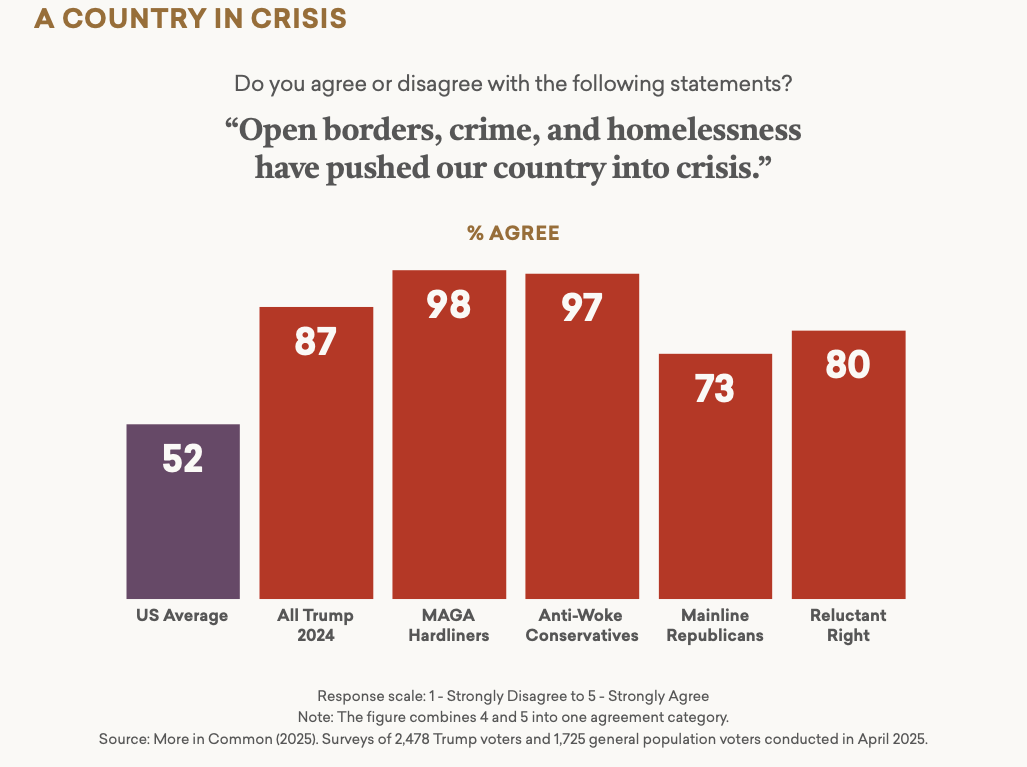
87% of Trump voters agree. Since the country split evenly in 2024 between Trump and non-Trump voters, only 17% (52% - (87% - 52%)) of non-Trump voters believe the country is in crisis.
87% vs. 17%.
This enormous gap shows how competing narratives divide — and keep divided —Americans.
If you believe the country is in a crisis, that your proverbial house is on fire, you are going to have a difficult time being patient with people who don’t think it is.
And if you believe the country is not in crisis, you are going to think anyone who tells you it’s in crisis, that the house is on fire, is crazy.
The belief or disbelief in crisis comes in multiple political stripes, too. Millions of Americans think something is a crisis — like municipal police reform in 2020 or ICE in 2026 — that millions of others do not.
Emotional decision-making governs us and fuels the partisan fire. Sometimes with deadly result.
Does it need to? No. Certainly not. But let’s keep unpacking why these stories are so forceful.
Certainty Trap
Americans cocoon themselves politically. As is well known. You can see it in the lawn signs in neighborhoods testifying to the beliefs shared. Or in the types of cars people drive. And certainly, in the media people consume: this week I watched Fox News and MSNBC each for 5 minutes and they each immediately and overwhelmingly confirmed every viewpoint I held about them.
Political self-segregation is also evident in the fact that only 57% of left-wing Democrats have a good friend who is a Republican. (The number is 79% for right-wing Republicans.) And in the fact that 40% of Harris voters think it’s okay to cease contact with a family member over politics. (The number is 11% for Trump voters).
We are certain we are right. It is obvious we are right.
It’s everyone else who needs to change.
When you combine this certainty trap with emotional decision making, you get the crisis-to-crisis churn of American political behavior.
Cicero, Universalism, and Customs
Roman consul, orator, and writer Cicero watched the 450-year-old Roman Republic die. It had been ill since long before he was born, and his life mission was to firm it up. He was both a statesman and a philosopher, and for this reason many of America’s Founders admired him. He is a useful teacher for anyone seeking to preserve their republic.
In his philosophy, like many philosophers’, Cicero seeks eternal, universal truths. In particular, he believed in natural laws:
“All people at all times will be embraced by a single and eternal and unchangeable law.”[1]
“Troubles and joys, desires and fears, haunt the minds of all alike…. What community does not love friendliness, generosity, and an appreciative mind which remembers acts of kindness? … The whole human race is seen to be knit together, the final conclusion is that the principles of right living make everyone a better person.”[2]
In addition to believing that there was only one, “single and eternal” correct set of “principles of right living,” Cicero also recognized that:
“People’s customs, in fact, are vastly different”[3] and
Rome’s original civil laws were both “in accordance with nature which is the criterion of law” or otherwise “based on custom.”[4]
Examples of customs he gives include rules about: funerals, tombstones, property boundaries, public and private holidays, music, and speeches.
In other words, Cicero held that while there were universal principles that should apply to all society as moral imperatives, there were also many customs unique to each society that need not be embraced by all.
There’s a problem here, though.
Universal truths hold a seductive power in the minds of men. As 20th Century philosopher Isaiah Berlin attests, the belief that there is one universal truth, “only one true answer to every question,” leads to “unlimited despotism.” It is “the root of every extremism.” It is “an enormous intellectual fallacy.”[5]
But fallacy or not, the belief in universal truths becomes a despot of our minds. Since we are social beings, when everyone around us believes the same truths, we are much more likely to believe we are all seeing the single Universal Truth.
Behind Americans’ political flamethrowing today, I see this reality playing out: the belief not that your view is a culturally distinct narrative from mine, but rather that my view is the correct and universally true one.
Emotional decision-making, the certainty trap, and a desire for universal truths combine to make people rush headlong into blazing sermons and acts of moral zeal that diminish others, their dignity, and their lives.
Is vs. Ought
David Hume, one of my favorite scientists and thinkers, was one of the first people to highlight an important difference that helps us escape the conflagration of emotional decision-making, certainty, and desire for universal truths.
It is the difference between ‘is’ and ‘ought.’
‘Is’ is the state of things as we describe them. I’m hungry. I’m angry.
‘Ought’ is the correct moral behavior. I ought to say thank you to my dinner host for feeding me. I ought to go to church every Sunday because I owe that to God and community.
What makes something moral is that we judge that we ought to do it. Not that it is.
Animals judge, too, but based on instincts. Something fearful should be avoided. Something desirable should be pursued.
But a human being is capable of judging not only on feelings but also on abstraction.
As contemporary American philosopher Christine Korsgaard argues: a human being can reject a potential action not because of her fears or desires but also because she makes a judgment about whether to lean into that fear or desire.
A person is “conscious that she fears or desires the object, and that she is inclined to act in a certain way as a result… She does not just think about the objects that she fears or even about its fearfulness [but also] about her fears and desires themselves.”
The consequences of our ability to abstract and look at our feelings from a distance and then decide matters because:
“Once you are aware that you are being moved in a certain way, you have a certain reflective distance from the motive…. You are in a position to ask yourself, ‘but should I be moved in that way? Wanting that end inclines me to do the act, but does it really give me a reason to do that act?’”[6]
So though we always react based on moral emotions, we can sometimes pause and think “should I be moved in that way,” ought I act in that way. And we can then act differently and according to our slow-thinking judgment.
Only You Can Prevent Forest Fires
The More In Common report does an admirable job thinking slowly about problems and identifying underlying complexity. They determine, for example, that the same percentage of Trump supporters as the population as a whole feels warmth toward legal immigrants (71%) and that this percentage is even higher than the warmth Republicans feel toward MAGA members (67%).
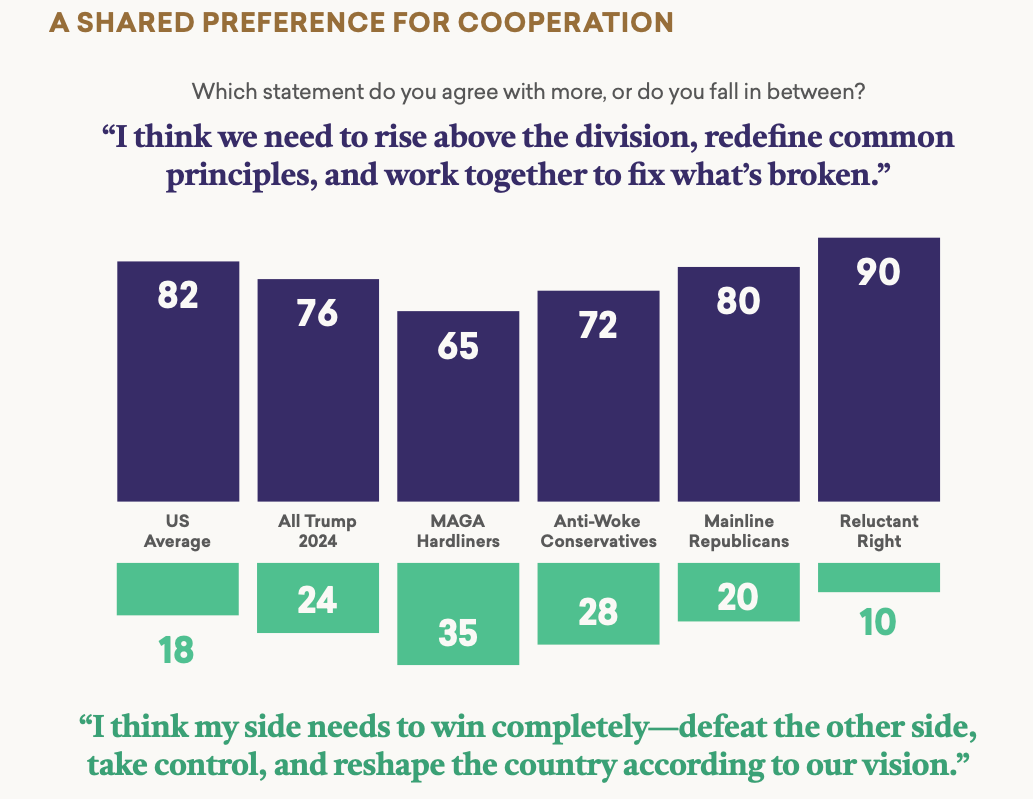
And they identify that – despite whatever partisan media you may bathe your neurons in – a massive preference exists amongst all Americans for cooperation over division. Asked if Americans should: “Rise above the division, redefine common principles, and work together to fix what’s broken,” 82% of all Americans and 76% of Trump voters agreed. Amongst even the most ideologically rigid Trump voters, still two-thirds feel that way:
Longtime depolarizing advocate Zachary Ellwood has written that “the ‘forest fire’ of toxic polarization would die down substantially” if fewer people kept constantly lighting small fires by writing, posting, saying hatefully toxic things.
For people to stop providing tinder for the conflagration of internecine fighting, they each need to pause, think slowly, and ask themselves: but should I be moved in that way by that video, blog post, news story?
Is that naïve to think people will choose slow thinking and rise above division? Eighty-two percent of Americans don’t think so.
Okay, but is it at all realistic that people can choose to think slowly? Well, take a minute. Or two. Or five. Decide for yourself.
[1] Cicero, Republic, III:33
[2] Cicero, Laws I:32
[3] Cicero, Republic III:16
[4] Cicero, Laws II:61.
[5] Berlin, Isaiah. “My Intellectual Path.” Available online: https://assets.press.princeton.edu/chapters/s10112.pdf
[6] Korsgaard, Christine. As written in Franz, de Waal, Primates and Philosophers. Princeton University Press, 2006. p. 111-112