
Democracy's Moxie
Meaning through words

Democracy’s got moxie
Don’t let authoritarians’ conceit
mislead you to fear defeat
The truth is in the name
What’s in a Name
Monarchy: from the Greek monos “alone” and arkhein (ἄρχειν), “the first, the ruler.”
Oligarchy. The “few” who are “the first, the rulers.”
But we don’t call it Demarchy.
We call it democracy because the ancient Greeks did in the 5th century BCE.
Democracy comes from the combination of town/the people “Demos” (δῆμος). But not with Arkhein, the rulers.
Instead, it’s with a more impressive word.
“Cracy” comes from Kratos (Κράτος): power, strength, might. Kratos: the apotheosis of strength. Zeus dispatched Kratos to enforce divine will. Kratos was brother to Victory (Nike), Force, and Glory.
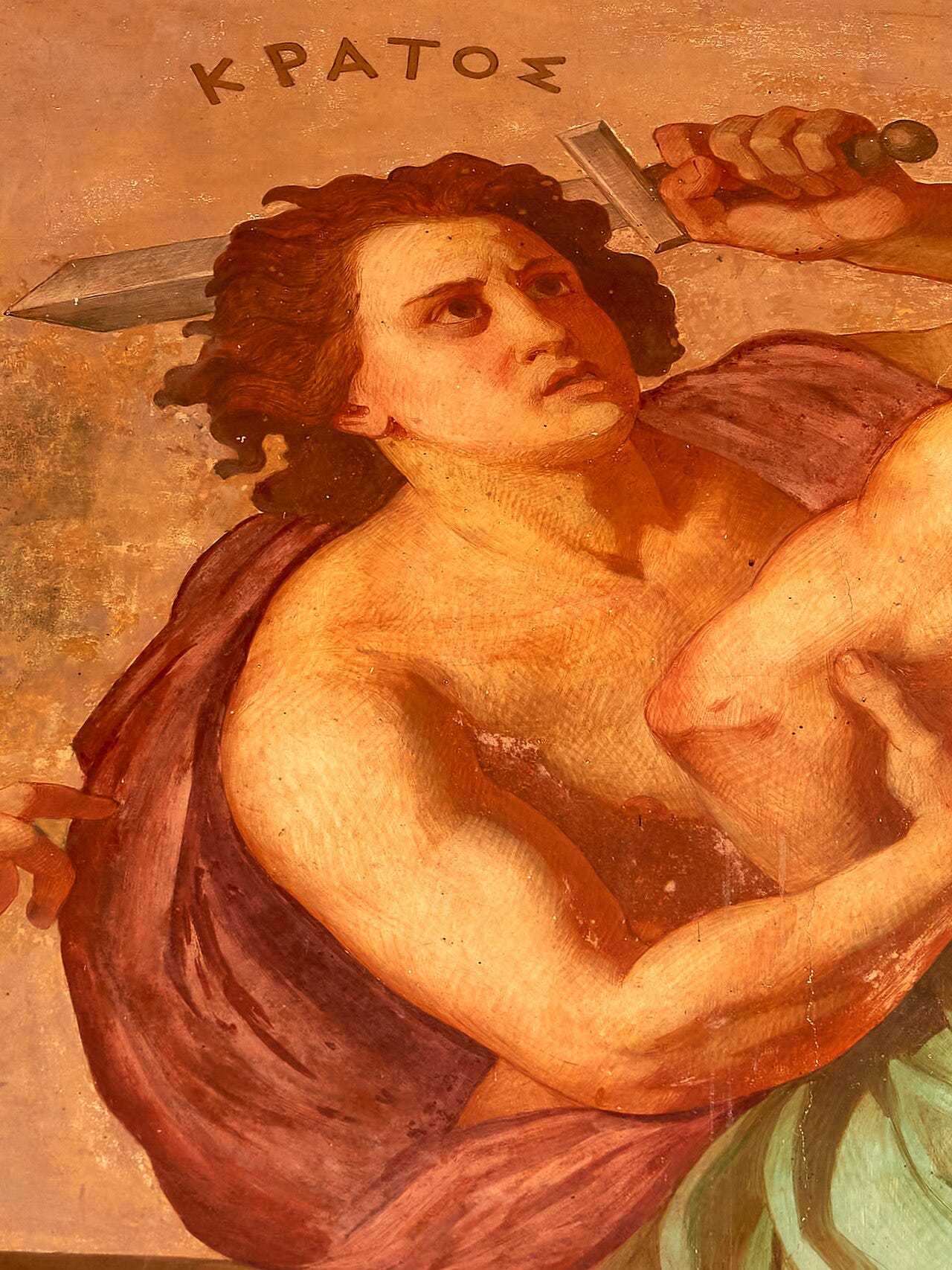
Kratos befits the name of the government. Democracy is not merely “rule by the people.” It is the “Power of the people.”
For good reasons, many ancient Greek philosophers feared democracy. They saw it as raw, mob rule. They thought it needed to be tamed, and so Aristotle called democracy the corrupt form of Polity, what the Romans termed the “mixed constitution.” This is a system we would recognize today: popular sovereignty subject to checks and balances of constitutional laws, judicial powers, and multilayered local governments.
From Adam to Moses to Invisible Hands
It is instructive that Herodotus, who provides us one of the first written records of “democracy” (δημοκρατία) used it interchangeably with “isonomia” which means equality under the law (‘Isos’ “the same” and ‘nomos’ “laws”).
The connection between equality under the law and democracy had a profound impact on American history because of the Hebrew Bible. As scholars have pointed out, the biblical revelation at Mount Sinai is so important for two reasons:
It was revelation to many not to a select few and
It was law attributed to a divine authority not human.
Hammurabi’s code was available to all, but as long as kings were divine, they could rewrite those laws as they wished and not be subject to them.
Other societies subjected themselves to divine not human authorities, but the truth was revealed only to an elect few.
In both cases, the powerful could remain above the law, which makes everyone else subject to the powerful rulers.
The Hebrew Bible’s greatest impact on human history was this: a broad-based insistence on equality under the law including over any human kings.
This Biblical legacy shaped the 17th-century English philosophers desperate to find sources of social stability after the English Civil War.
The most salient feature of Hobbes’s Leviathan is that the work is actually just 600 pages of Biblical commentary quoting scripture 500 times (in fact, more than 500). It uses biblical authority to establish a few key lessons about the structure of stable governments.
Similarly, John Locke’s treatises of government start with the premises of the Hebrew Bible and the story of Adam. Literally the opening line is:
“Adam had not, either by natural right of fatherhood, or by positive donation from God, any such authority over his dominion, or dominion over the world” and as a result: “that in the races of mankind and families of the world, there remains not to one above another.”[1]
This search for public stability carried over to an 18th-century Adam, Adam Smith, who studied the mechanics of market transactions to show that in business, individuals acting in their own self-interest promoted domestic peace:
A man “intends only his own gain” in producing goods that will be “of the greatest value” and “he is in this… led by an invisible hand to promote” society’s good.[2]
The solution, said Smith, was not Hobbes’s all-powerful monarchy, but a well-organized, culturally-disciplined, deeply-sympathetic democracy of individuals freely pursuing their own economic good. Unleashing the people would create the most dynamic and stable society.
These ideas together bequeathed British democracy the practice of celebrating free individuals.
And even more so in America. The British-cum-Americans of 250 years ago revolted from an unyielding love of individual freedom, and ripped down the monarch’s statues, literally and figuratively. No more “monos” and “arkhein.”
In their place came “demos” and “kratos.”[3] No matter how many mercenaries King George III sent at them. With so many individuals unleashed and working together for the collective good, they found a way to win. The people united have unstoppable power.
Present Kratos
In 2026, every time I hear a person saying: “our democracy is dying,” “we’re turning into an authoritarian state,” or calls to “resist fascism,” I feel sad, angry, anxious, or annoyed. On the one hand, I fervently agree that we should always jealously guard our democracy and freedoms. We should be overly cautious about any encroachment on them. I spent my life, especially the last decade, researching this topic and wrote a book about it.
But to my (and the courts’) judgment roughly 5% of what people warn is destroying democracy are actual attempted violations of the rule of law by the President—nearly all of which get struck down by courts or popular opposition. The other 95% of what people warn is destroying our democracy are simply actions they dislike: denigrating allies, belittling fellow citizens, and reducing services for the vulnerable. Which of course pisses off many people! But that’s not the same as democracy in danger.
I therefore take righteous outcries as evidence for my new favorite etymology: kratos. The force, the drive, the will to individual power that stirs Americans all across the political spectrum.
America, I believe, bursts with power (Michael Beckley penned a brilliant, optimistic, and cautious Foreign Affairs analysis about America’s unique global power). America is the pre-eminent military power on earth, so it won’t be easily conquered. And the source of that power is a mass of people who are wild lovers of their own freedom. And eighty percent of them share the same values, make the same moral decisions, and want to work together as one nation.
I look at these facts and I think: What a gift. Democracy carries the inherent risk that the ancient Greeks (and modern French) witnessed: mobs choosing to surrender their power to a monarch or getting conquered by foreign powers. But America faces no such risks.
So, the next time you hear someone predicting American democracy’s death and feel an ache (for whatever reason), you might think: “I must jealously guard my democracy from aspiring autocrats and foreign enemies”
But consider thinking, also: “The power of the people, the kratos of democracy, is unstoppable, and I get to be a part of it.”
Because partisan opponents who treat each other as threats to democracy are all driven by the same motivation—which is also the very source of American democracy’s might: the righteous, tenacious power of free and equal people.